Showing posts with label temari history. Show all posts

Sunday, May 13, 2012

A Mother's Love


Present for my mother, a musical temari ball
It's funny how sometimes you keep running into stories that express the same feeling, the same idea, the same quality of human nature. This happened to me four times this past week so I thought I'd better pay attention. Enjoy this moment, be present with it, and learn. The message is that when you make something by hand and thoroughly enjoy the process, you put something of yourself into that creation - your love and good spirit. Be sure you give some of these things to your children and loved ones. You will strengthen your family bond and pass on your love of creativity.

I've been watching the PBS series Craft in America. Have you seen it? The first episode is called "Memory."  This episode profiles several craftsmen and women who explain what their work means to them and their families. I particularly like the story of the family in South Carolina that has been passing on the skill of weaving baskets with native grasses for several generations.

"Unlike fine artists, who perhaps capture a moment in time, and are more concerned with an artistic style and technique, craft artists, through their objects, go beyond telling where we were, making a statement of who we are. Their objects will create memories for us, because the artists give selflessly of their memories in creating the objects. "

Sensei Ozaki wearing Glenna's corsage
I came upon this same thought when I was looking for something online and came across a translation of a newsletter from the Japan Temari Association. This was not part of my search but Sensei's words made me think of the PBS shows that I've been watching.
 
"A message from the President  of the  Japan Temari Association, Ms. Thoshiko Ozaki.

We are enjoying Temari making from ancient days; now we also can create many modern designs and enjoy stitching them into our Temaris. The pleasure that it gives us when we finish making new Temari is incomparable to anything else in the world, and such a beautiful feeling of achievement saves us from other small worries that are brought to us in our daily lives. As we continue to learn more about Temari making, we must nurture our feelings THAT CAN FEEL BEAUTY in this world, and convey this kind of knowledge to others. Further more, this kind of gesture will help our Temari making to flourish even more in the future. I feel that in every stitch that we weave into our Temari, we are stitching into it various feelings as well as memories, and this is how we create new Temaris. Please treasure such important feelings and memories that go into making Temari to produce your own Temari in the future. Continue to pass on the tradition to the next generation. This is my sincere wish that I like to convey to the members of Temari Association. Thank you.
(translated by Tomiko san)"


Hometown Temari  by Arai
This morning I picked up my new book, the advance copy that my publisher sent me, and flipped to the page about the book Furosato no Temari or Hometown Temari by Tomokazu Arai which was published in Japanese in 1990. The last paragraph (yes, I wrote it so you'd think I would remember) helped me make the connection between the PBS show, Sensei's words, and the words of Mrs. Nori Furuta (below).

From page 8 in Temari Techniques: The author traveled across the country and interviewed temari makers to document how they learned the craft as well as their techniques and designs. Furosato no Temari is filled with photographs of temari and the stories behind them.

From its very beginning, temari has exemplified a mother’s love for her child. In many regions, temari are handed down from generation to generation. The one thing all temari have in common is that they were made by mothers to show love for their children. Mrs. Nori Furuta said, “Every time I hold these temari my mother left for me, I remember my mother. They make me happy but a little sad at the same time since I feel that my mother is still talking to me.”

Yesterday, I got the best mother's day present from my daughter who is away at grad school in Wisconsin. Four times in one week - that same message! I was a bit dismayed when she decided to work in a lab but she assured me that she can be very creative there. She's a very talented gal and could have been an artist or a writer (my motherly pride is showing here). Anyway, she sent me a photo titled "Pretty colors today." Yep, that's my kid. I guess I succeeded in passing on my love of color and creating. I love you, Alison!

Creative chemistry


Wednesday, January 26, 2011

How to make a temari ball

 
To make a temari:
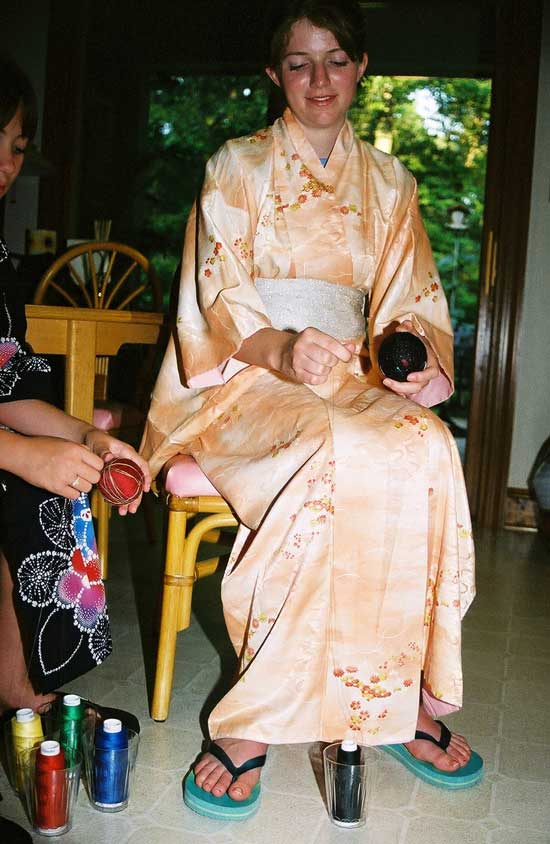
first, dress in kimono (just kidding!)

Isn't she lovely?! My daughters always loved to dress up and were happy to wear kimono for an afternoon and let me take some photos. I took this about eight years ago to show how to wrap the core with thread. There is a lot of information on my website about making temari. The list of temari techniques is on a How-To page.
Tips on making the ball are on a separate page here: How to make a round Japanese temari ball.

Back when I took that picture, I used to place cones of serger thread in cups on the floor for the last steps in the wrapping process. Now, I don't use the cups since the cones stand up just fine without the cups. The trick is to keep the cones of thread close together and hold your temari directly above them. Then wrap, watch TV, watch a movie, relax, listen to music or whatever you like to pass the time while you cover the ball with thread. Click on those links above to learn more about making a temari ball.

Hometown Temari by Tomokazu Arai
One of the best investments in temari I ever made was getting this book translated. It was published in Japanese in 1990. The author traveled across the country and interviewed temari makers to document how they learned the craft as well as their techniques and designs. By the photos of the artists in the book, I can see he interviewed a lot of old ladies! Furosato no Temari is filled with photographs of temari and the stories behind them. 

The ingredients they used in their temari were mostly natural and taken from what was abundant around the residence of the artist. A traditional way to make the core in Tsuruoka City was to take a clamshell, fill it with sand, pack wood chips around it, then wrap it again with zenmai (fern fibers), and complete by wrapping the core with thread.

In the old days of Matsumoto, people went into the mountains and collected cocoons to use as cores. They rolled fern fibers around them, then stitched the design with thread dyed with plant extracts such as indigo. In many cases, the stitching was only the last, small part of the whole process. 

A temari maker from Muraoka used grass seeds for the core to make her temari hard enough to bounce.

In Shuugetsu temari, a seashell with a small stone in it was used as the core, then wrapped with rice husks. This temari made a very light sound when shaken. 

I hope these little stories inspire you to look around your home and garden to select ingredients for the core of your temari that will not only make a good ball for stitching but have some meaning when it's all done. When making temari as a gift, that's what I do. Think about the recipient and look for meaningful ingredients. I might make a little noise box and fill it with sea shells, shiny beads, or beans. Drop that into a sock filled with dried lavender or a rice hulls/rose petal combination. Wrap with yarn leftover from an old craft project. And finally cover the ball in a thread color I think he/she will like. It seems I'm usually making temari in quantity for publication or teaching projects, so I don't take the time to do all this "feel good" preparation. But I sure love it when I do.